
The dollar devaluation has seen revenue loss incurred by state-run oil firms on fuel sales trimming to about Rs 96 crore per day.

Indian Oil Corporation sought an increase in prices of petrol, diesel, domestic LPG and PDS kerosene on Tuesday as spiralling global oil prices had put "enormous" burden and may result in a revenue loss of over Rs 8,500 crore (Rs 85 billion) this fiscal. While the government and oil companies were bearing their share of the burden, the consumers have so far been spared from any hike in fuel prices despite crude oil touching a historic high of $93 per barrel.

The Reserve Bank of India (RBI) on Wednesday announced to increase the policy repo rate by 50 basis points to 4.9 per cent, the second hike in five weeks aimed at quelling the inflation. The MPC vote was unanimous and has decided to keep stance withdrawal from accommodative, RBI Governor Shaktikanta Das said in a press conference on Wednesday. The decision was taken during a three-day meeting of the RBI's Monetary Policy Committee (MPC) to review the interest rates in the country. The MPC voted unanimously to increase the policy repo rate by 50 bps to 4.90 per cent," Das said.
Excise duty on petrol will remain at Rs 14.35 a litre and diesel at Rs 4.60 per litre.
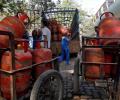
Global crude oil prices have slumped by 49 per cent during the same period
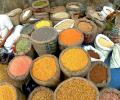
Prices of food items like cereals, pulses, and edible oils rose or remained steady in May, a Reserve Bank of India (RBI) report said, indicating there could be another higher inflation print. However, it observed that the Monetary Policy Committee's (MPC's) surprise move to increase interest rates bodes well for its credibility. The RBI's monthly State of the Economy report, released on Tuesday, citing high frequency food price data from the Ministry of Consumer Affairs for the period May 1-12, said the increase in the prices of cereals was primarily because of the surge in wheat prices.
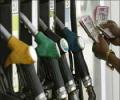
Price of petrol may go up by Rs 4.70 a litre and diesel by Rs 2.30 a litre.

Bharatiya Janata Party MLA in Chhattisgarh and former state minister Brijmohan Agrawal has stoked a controversy as he said that those who call inflation a national calamity should stop eating food and using petrol.

The Planning Commission on Tuesday called for linking petrol and diesel prices with international markets and made a case for raising gas prices by public sector companies.
The goverment on Wednesday ruled out any increase in petrol and diesel prices despite international crude oil prices touching an all-time high.

Increasing the duties on auto parts and putting an additional cess on petrol and diesel could drive up costs of vehicles, specially where volumes are low and localisation is not viable.
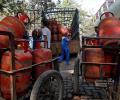
Petroleum and oil marketing companies raised the price of commercial liquid petroleum gas (LPG) cylinders by Rs 350.50 per unit and domestic LPG cylinders by Rs 50 per unit with immediate effect from Wednesday.
The initial purchase cost for an electric car may be high, but savings on fuel will help it pay back for itself in just a couple of years, if not faster.
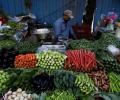
Retail inflation eased to 7.04 per cent in May, mainly on account of softening food and fuel prices as the government as well as the RBI stepped in to control spiralling price rise by way of duty cuts and repo rate hike. However, the inflation print stayed above the Reserve Bank's upper tolerance level of 6 per cent for the fifth month in a row. The Consumer Price Index (CPI) based retail inflation was 7.79 per cent in April.
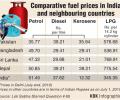
Petrol costs more in India, but cooking gas, kerosene and diesel cost less than in Pakistan or Sri Lanka.

The Shiv Sena has spurned Congress' request to participate in the bandh.
Price of diesel, LPG and kerosene will have to go up.
While hinting that further cut in petrol and diesel prices was likely during the next revision, Petroleum Minister Ram Naik on Saturday ruled out any possibility of increase in prices of LPG and kerosene

Premium carmaker Mitsubishi on Wednesday said it will increase the price of its newly launched sports utility vehicle Outlander by about two per cent from next month, thus withdrawing the introductory offer on the vehicle.
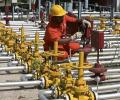
The oil ministry has stopped making fresh allocation of natural gas from domestic fields to the city gas sector, threatening the viability of Rs 2 lakh crore investment planned in the sector besides leading to a hike in CNG and piped cooking gas prices to record levels, sources said. Despite a decision of the Union Cabinet to give 100 per cent gas supply under 'no cut' priority to the city gas distribution (CGD) sector, current supplies have been maintained at March 2021 demand level. Besides, the process of allocating gas on a six-monthly average drawl also is punishing the CGD entities driving growth.

Opposition members in the Lok Sabha on Monday blamed the Bharatiya Janata Party-led central government's policies for the price rise and accused it of ignoring the plight of common people, saying kitchens will soon "see a lockdown" if the Centre does not take corrective measures.
Petroleum Minister Murli Deora said on Monday the Centre was trying its best not to increase the prices of petroleum products like petrol and diesel even though the international oil prices had registered an upward trend in the past few months.
As we spoke to people from various walks of life, they all conveyed their anguish over this 'unreasonable hike' and slammed the government for mismanaging the economy.
The government on Tuesday hiked the prices of petrol by Rs 2 per litre and diesel by Re 1 per litre, besides raising domestic cooking gas LPG prices by Rs 20 a cylinder in Delhi.
The government on Thursday rejected demands for a roll back in the hike in petrol and diesel prices, saying it would favourably consider the issue only when global crude prices come down.

Higher prices are burdening household budgets and threatening the margins of leading manufacturers.
State-run oil firms have sought a Rs 1.50 a litre increase in diesel prices to cover for the rising crude prices, but the government is unlikely to concede to their demand.

Buying a car, particularly a diesel-powered one, is set to pinch the customers' pockets even more from the next financial year, as the second phase of Bharat Stage VI (BSVI) emission norms kicks in. The rules require cars to be compliant with real driving emission (RDE) norms, which measure pollutants emitted by cars while they are being driven on the road, unlike in a laboratory test. The norms may increase the cost of producing diesel vehicles by nearly Rs 75,000 to Rs 80,000, and petrol-powered ones by Rs 25,000 to Rs 30,000, analysts said.
If drivers apply some common sense approaches, fuel bills can come down considerably.
If drivers apply some common sense approaches, fuel bills can come down considerably.
The government had, on June 25, freed petrol price from its control resulting in a hike of Rs 3.50 per litre.
Ford India is expected to increase the price of its newly launched premium sedan Ford Fiesta in about a month by Rs 20,000-Rs 30,000.

This is the second hike in excise duty in less than two weeks as the government looks to make use of the slump in oil prices to shore up resources.

Petrol and diesel prices will go up by Rs 2.67 a litre and Rs 2.58 per litre, respectively, after Finance Minister Pranab Mukherjee on Friday raised customs and excise duties on the two, virtually putting the Kirit Parikh Committee report on fuel price in cold storage.

Finance Minister Arun Jaitley on Wednesday said for the first time fiscal deficit target will be met without budgetary cuts.
Especially after the recent hike in petrol prices, car makers are trying to come up with frugal options that can make up for the spiralling fuel prices.
The petrol price hike has added to the woes of the common man.

If June 2010 diesel price is taken as the base, then the increase is a mere 2 per cent. By contrast, petrol prices have gone up by 23 per cent in the same period.
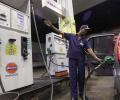
After the latest spike in crude oil prices, petrol prices could potentially go up to around Rs 90 a litre making a dent in the consumer's wallet. This, the analysts fear, will push the cost of vehicle ownership in the country, further reducing the demand potential for the industry.
